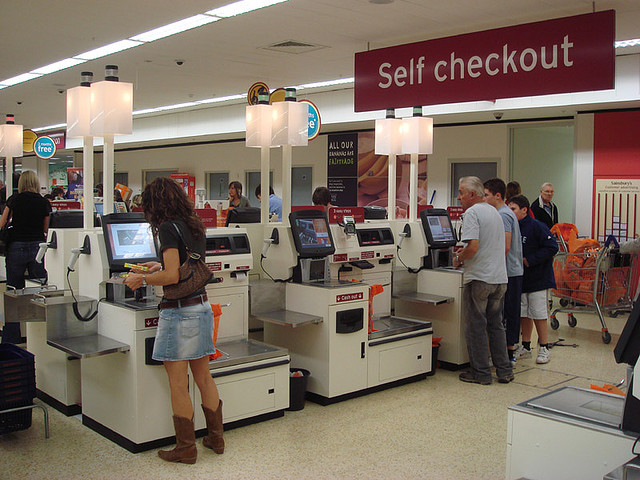
There have been many articles recently about the end of self-checkout at supermarkets and other retail. Naturally, Self-checkout of course was meant to be a way to reduce labor costs, but this would only make sense if losses from “errors” were manageable. (I’m giving shoppers the benefit of the doubt and saying errors, rather than theft.) It turns out that we’re not that reliable at scanning our own stuff.
Since these systems were devised as way to save money, the user experience took a back-seat. In fact, the approach taken was to largely offload the user experience of the trained and employed scanner to the user. Not surprisingly, this doesn’t translate very well. What works for “the pros” is not often going to work for the “amateur”. Within day, a paid employee will quickly gain experience scanning all manner of products, shapes, sizes. They quickly memorize the codes for common produce items. Together with an experienced bagger, they can more effectively bag your items and get you on your way. To make matters worse, the self-checkout process was actually made more difficult that the “pro”-process by weighing the products after scanning and raising hell when something doesn’t add up (“Unexpected item in the bagging area”). In a survey last year, 67% of shoppers said they’d experienced a failure at the self-checkout lane.
All of this of course leads to aggravation, and — not surprisingly — user “errors”. And yet, these self-checkout systems proliferated over the years and in most stores there are lines of people waiting to check themselves out. How could that be?
Like it or not, more and more people would simply rather not deal with other humans in a shopping environment. If there’s going to be an error or hold-up in the process, we want it to be our doing. We want it to because our can of beans won’t scan. Whereas if it happens to the person ahead of us in line, we might throw ourselves off a bridge. And it’s not jus us — employees don’t want to deal with impatient, aggressive shoppers either. Another casualty of the pandemic I suppose. So clearly the self-checkout system does a “job” other than simply paying for your goods: it lets you get in and out of that store without engaging another person. (Yes, Instacart does that too, but has other drawbacks.)
Meanwhile, Amazon as well as some startups are attempting to upend the whole paradigm with cashier-less checkout (“just walk out”). I appreciate the bold thinking. Unfortunately, this approach is encountering issues of its own. They are very expensive to install; they require a surprisingly large number of humans to support; and doesn’t quite work for large numbers of products in a basket. When it works, it’s very cool. But rather than trying to wow us with a magical experience, I would argue that they are overshooting the opportunity to make manual self-checkout process simply more user-friendly and user-capable. For example, cameras, scanners, and weighscales can work together to positively identify any object. Simplified/Unified pricing can make produce code lookups obsolete — just tap “fruit”.
We do want self-checkout. But we don’t need a revolution. We just make it work right.
 Consumer Musings
Leave a comment